Tuesday, December 9, 2014
Polar Bear, Arctic Hare: Poems of the Frozen North (Poetry)
This poetry book was written by Eileen Spinelli, and the illustrations were created by Eugenie Fernandes. It was published by Boyd Mills Press Inc. in 2007 and is recommended for second grade.
Polar Bear, Arctic Hare is a poetry book about the various animals in the icy North. There are also a few poems describing landscapes and weather. Each poem gives the reader a little information about its subject.
This is a good source of children's poetry because the topic is suitable and interesting for children. These are lyric poems that are free of didacticism. The rhyme schemes are natural and have rhythm. Metaphors and many examples of personification are used in this book as well.
Fernandes' acrylic illustrations fit each poem perfectly, and the realistic style is beautiful and very detailed. The illustrations enhanced the story and gave readers a visual to connect with while reading.
Before the activity, explain to the students what alliteration, rhymes, and the other concepts of poetry are. There are twenty-four poems in this book, so I would give each student a copy of one poem each; then they would label alliteration, rhymes, repeated lines, etc. in the poem to share with the class. They could also draw a picture to go with the poem like Fernandes' in the book.
CCSS.ELA-Literacy.RL.2.4
Describe how words and phrases (e.g., regular beats, alliteration, rhymes, repeated lines) supply rhythm and meaning in a story, poem, or song.
Stopping by The Woods on a Snowy Evening (Poetry)
This copy of Robert Frost's Stopping by The Woods on a Snowy Evening was illustrated by Susan Jeffers and published by Dutton Children's Books in 2001. It's recommended for first grade.
Stopping by The Woods on a Snowy Evening is a very popular Robert Frost poem. It's about a man stopping by some snowy woods to enjoy the peacefulness and beauty. He couldn't stay long though because he has a long way to go and "promises to keep."
This poem is a good source of literature for children because it's an enjoyable narrative poem that reminds us how beautiful snow can be. Frost describes it perfectly I think, and reading this could change the way children normally view snow. The rhyme scheme flowed naturally, but there were no examples of similes or metaphors. This poem has a light-hearted tone and was free of didacticism and patronizing language. Every child should read this short poem at some point.
Jeffers' illustrations in this book are personally some of my favorites ever. I could not find anything that says what Jeffers used, but most of the pictures look like they were done in pencil. The tone of the story was reflected by each illustration, and all pictures and details were in harmony with the text. The illustrations enhanced the poem greatly.
While reading this story, pause after each page and talk with the class as a group about how each line makes them feel. For example, when it says, "The only other sound's the sweep of easy wind," ask them how the man must feel in the poem. They should agree that he is probably cold, and the wind is the only thing he can hear. When it says, "The woods are lovely, dark, and deep," have them talk about a time they've experienced the snowy woods too. This will familiarize them with poetry and the poem itself.
CCSS.ELA-Literacy.RL.1.4
Identify words and phrases in stories or poems that suggest feelings or appeal to the senses.
The Surrender Tree (Poetry)
The Surrender Tree was written by Margarita Engle and published by Henry Holt and Company, LLC in 1866. It is recommended for seventh grade and above. This book has received a Newbery Award and a Pura Belpre award for writing.
The Surrender Tree is a five part book of narrative poetry about Cuba's struggle for freedom. A girl named Rosa grows from a young girl to an older woman throughout the book. She is a very famous healer. Everyone during the wars wants to find her, even Spain's soldiers, the enemies.
These poems let readers get to know Rosa's thoughts and feelings along with her husband's, a girl named Silva, and Lieutenant Death's. Lieutenant Death is the enemy which gives us a different point of view during the wars.
The Surrender Tree is recommended by me as a good source of poetry for children because it's a great example of narrative poetry. The story draws readers in and is captured by different points of view. Along with the entertainment of these characters' story, it's also educational. Many historical events mentioned in the poems actually happened.
The poems are free of didacticism and patronizing language, and children will be able to pick out many examples of personification, metaphors, and rhythm. I think The Surrender Tree will help students view the Cuban wars differently after reading these victims' stories.
After the students read this book, go over the types of poetry and their forms: lyric, haiku, narrative, sonnet, etc.; then explain why this book was narrative. They should then be able to answer these discussion questions:
- What type of poetry is The Surrender Tree and what does that type of poetry mean?
- What is one example of personification in this book?
- What is one example of a metaphor in this book?
- Who is the main character?
- Who was the Cuban war against?
- Why did Rosa help heal the enemies?
- Who was Silvia?
- Why did Lieutenant Death want to kill Rosa?
- Why did the author write this book with many different points of view?
- Did the story flow from one character to another as the story went along, or were different characters repeating the same part of the story in their points of view?
- Which characters were on Rosa's side?
- Which characters were on Lieutenant Death's side?
- Who was Rosa to Lieutenant Death at the beginning of the story?
- Did Lieutenant Death ever kill Rosa?
- Why are they "free to dream" at the end of the story?
CCSS.ELA-Literacy.RL.7.5
Analyze how a drama's or poem's form or structure (e.g., soliloquy, sonnet) contributes to its meaning.
CCSS.ELA-Literacy.RL.7.6
Analyze how an author develops and contrasts the points of view of different characters or narrators in a text.
Monday, December 8, 2014
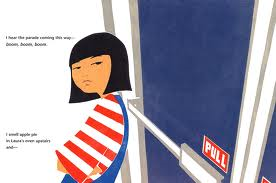
Apple Pie 4th of July (Culturally Diverse)
Apple Pie 4th of July was written by Janet S. Wong and illustrated by Margaret Chodos- Irvine. It was published by Harcourt Inc. in 2002 and is recommended for second grade.
A Chinese-American girl thinks that no one will buy her parents' Chinese food because it's the 4th of July. She is later proven wrong and many people buy the food.
Apple Pie 4th of July is a great example of good culturally diverse literature. The girl in this story assumes that no Americans eat Chinese food on the 4th. She is later proven wrong, so that stereotype is diminished. Her Chinese family ate apple pie that day also proving that Chinese people don't always eat Chinese food. In the story, Laura, a Chinese family member, makes apple pie, and their family watches the fireworks that night making them multidimensional characters. All cultural details were authentic and naturally incorporated into the story. This book helps children understand that all people are different, and stereotypes are not accurate.
Chodos- Irvine's illustrations were created using a variety of printmaking techniques that enhanced the story perfectly. They reflected the text and tone of the story with their folk art style.
The students should be able to answer these discussion questions after reading Apple Pie 4th of July:
- What is the ethnicity of the girl in this story?
- What is the ethnicity of the girl's parents in this story?
- What business does her family have?
- What is this only day they close?
- What day is it in the story?
- Why doesn't the girl think her parents will sell any Chinese food today?
- What is Laura making upstairs?
- Does anyone buy the Chinese food?
- Were the girl's parents right?
- What did the girl and her family do that night?
CCSS.ELA-Literacy.RL.2.1
Ask and answer such questions as who, what, where, when, why, and how to demonstrate understanding of key details in a text.
Secret Place (Realistic Fiction)
Secret Place was written by Eve Bunting and illustrated by Ted Rand. It was published by Clarion Books in 1996 and is recommended for second grade.
A little boy and a few of his friends that live near-by found a place in their bustling city where wildlife has made its way. It is really odd because everything around them is city-like, and it doesn't fit. The little boy is amazed at all of the animals he sees that live there, and after being told that someone may change this area, he decides to keep it his "secret place."
Secret Place is a good recommendation of realistic fiction for children because it brings to light something children don't hear about much. Wildlife is destroyed all the time by cities, and animals are left to survive on what's left. This animal-themed story is enjoyable and suitable for young children. Bunting also avoided any possible stereotyping by including various ethnicities. The plot is credible and the characters come across very convincing. Any group of city people would be intrigued by the "secret place" described in the story.
However, without Rand's beautiful illustrations, this story wouldn't have been as wonderful. His watercolor paintings flowed well with the text and enhanced it greatly.
Before reading the book, take the students outside to look at the nature around them. This should prepare them to observe the animals more closely in the story later. When you read the book to them, they should listen carefully to the descriptions of the animals and use the illustrations as a prompt to create opinions or predictions. Have them write a response about what they think will happen to the animals in the story and why.
CCSS.ELA-Literacy.RL.2.7
Use information gained from the illustrations and words in a print or digital text to demonstrate understanding of its characters, setting, or plot.
CCSS.ELA-Literacy.W.2.1
Write opinion pieces in which they introduce the topic or book they are writing about, state an opinion, supply reasons that support the opinion, use linking words (e.g., because, and, also) to connect opinion and reasons, and provide a concluding statement or section.
Night Tree (Realistic Fiction)
Night Tree was written by Eve Bunting and illustrated by Ted Rand. It was published by Scholastic Inc. in 1991 and is recommended for second grade.
A boy and his family go out to the woods every year for Christmas and find the same tree. They decorate the tree with bread, apples, and other foods for the animals; then they sit beside it and sing Christmas songs.
Night Tree is good realistic fiction because it's a family-themed story that shows a happy family spending time together for the holiday. Even though they seem to be a perfect family, the little sister in the story "doesn't like to be left out," and the big brother makes fun of his sister's song choice just like any real siblings would. The characters were very convincing. This story is enjoyable and suitable for young children, and I recommend it to anyone looking for a good Christmas story.
Ted Rand's illustrations enhanced Night Tree with beautiful watercolor pictures that harmonized with the text of the story. Along with watercolors, chalk and grease pencil were used making the perfect combination to create the visuals. The dark greens and reds really gave the story the "Christmasy" feel it needed.
The best time to read this book to a class would be at Christmas! After reading it aloud, I'd read a short story about what my family does as a Christmas tradition; then after they'd seen my example, they'd write their own. Actions, thoughts, and feelings about their specific tradition should be included, and they should use words like "first," "next," and "finally" to move through their story smoothly.
CCSS.ELA-Literacy.W.2.3
Write narratives in which they recount a well-elaborated event or short sequence of events, include details to describe actions, thoughts, and feelings, use temporal words to signal event order, and provide a sense of closure.
Thursday, December 4, 2014
Ramona Quimby, Age 8 (Realistic Fiction)
Ramona Quimby, Age 8 was written by Beverly Cleary and published by Scholastic Inc. in 1981. Apart from this one, Cleary has written seven other books about Ramona. This one, however, has won a Newbery Honor Award along with many other acknowledgements. It's most recommended for third grade.
Ramona Quimby, Age 8 is about Ramona going to third grade. She has to make new changes and get through some tough situations. Ramona has to ride the bus for the first time, deal with a bully named Yard Ape, and be babysat after school by her boring teacher!
This book is good realistic fiction for children because it's suitable and highly relatable to kids Ramona's age. Family relationship, friendship, and social reality themes are included in this book. Ramona constantly worries about her family's money problems throughout the story. This is relatable to many kids' families and should be included in books for children, so they know it's a normal thing. The plot and characters are easily convincing. Every kid has a teaser like Yard Ape in their class, and everyone, including me, knows a "Ramona."
I did come across one thing to be aware of when handing this book to a third grader. While reading this book out loud to my younger brother, I found that some of the language used was outdated, and he didn't understand. Cleary used the word "checker" instead of cashier and called the grocery store the "market," but it was written at the beginning of the 80's, so it's understandable.
Other than that, I think Cleary created a typical world for a third grader and made it entertaining enough to draw kids in. Because it's so popular, she's written seven more in this series. I recommend Ramona to every third grader out there.
I think the most enjoyable activity for this book would be to have the students compare themselves to Ramona. First, I'd have them write down all of their ideas in a graphic organizer (Venn Diagram, bubble chart, T-chart); then they'd write the story. They should focus on descriptive details and make sure that when they're describing Ramona, it's an accurate representation from the book.
CCSS.ELA-Literacy.W.3.3
Write narratives to develop real or imagined experiences or events using effective technique, descriptive details, and clear event sequences.
Subscribe to:
Posts (Atom)